Narayana Hrudayalaya Heart Hospital: Cardiac Care For The Poor (A) Download UPDATED
Narayana Hrudayalaya Heart Hospital: Cardiac Care For The Poor (A) Download
Background
Health system leaders worldwide are searching for innovative care delivery models that lower costs, improve quality, and increase access to services. Bharat's Narayana Health is one of the best-known examples of a health system that has achieved these goals.
U.K.-trained cardiac surgeon Devi Prasad Shetty, M.D., who served equally Female parent Teresa's personal md after operating on her following her heart set on, founded Narayana Health in 2001 in Bangalore. Its mission: to provide high-quality, affordable cardiac care to everyone, regardless of ability to pay. Changes to Indians' lifestyle and diet in recent decades have led to an unprecedented increase in centre disease.i Effectually the time Narayana Health was founded, approximately 2.4 1000000 Indians required heart surgery annually, only prohibitive costs and a shortage of providers meant only threescore,000 received information technology.2
- India's Narayana Wellness: A Model of Efficient, Loftier-Tech Intendance
This gap inspired Shetty to create what is today i of Republic of india's largest multispecialty hospital chains, comprising 31 third hospitals across nineteen cities. By combining innovative technology and a highly efficient delivery organization, Narayana Wellness is able to optimize productivity and minimize costs. This has enabled it to both increase treatment capacity and expand the number of specialty services offered. In early on 2016, the company'south share price rose more than than 35 per centum in its initial public offering.
This case written report describes the Narayana Health model and the challenges the health system has faced in opening a new hospital in the Caribbean area island of Grand Cayman. Information technology likewise offers lessons for U.S. health intendance payers and providers on ways to dramatically reduce costs while maintaining high-quality 3rd intendance.
Key PROGRAM FEATURES
Narayana Health is designed for India, where the majority (58%) of health expenditures are paid out of pocket, given that most people finance their ain care.3 The success of the model is achieved through several complementary mechanisms. These include:
- leveraging economies of scale
- using assembly line concepts for surgery
- reducing the boilerplate length of stay
- reengineering the design, materials, and utilize of medical equipment to reduce the cost of ownership.
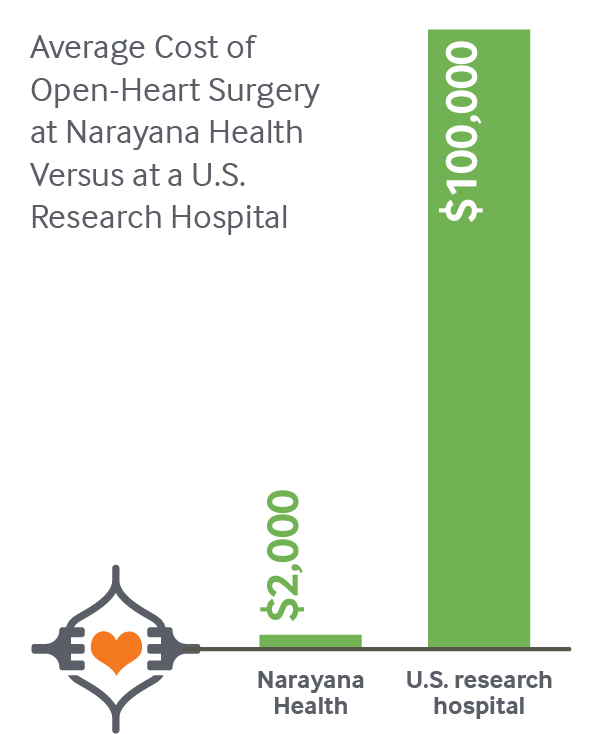
Because of these innovations, the average price of open-heart surgery, as reported by Narayana Health, is less than $2,000. The same process at a U.South. research hospital typically costs more than $100,000.4
A Tight Focus on Efficiency
Narayana Health has achieved savings through smart use of equipment and telemedicine as well equally efficient staffing procedures. The wellness organisation has built reliable and low-price supply bondage in India over the past decade and leverages economies of scale to further bulldoze downwards prices. Utilizing a pay-per-use model with suppliers for some diagnostic equipment, it minimizes upper-case letter costs.5 Strict sterilization procedures, permitted by the Joint Commission International, enable reuse of some devices, such as guide wires and certain cardiology catheters that are typically tending of later a single apply. Centralized purchasing allows the system to accept advantage of economies of scale. Bar coding of stock enables precise inventory counts at whatsoever time, minimizing storage costs and preventing unnecessary spending.
In improver to offering services at its own facilities, Narayana Health has one of the earth's largest telemedicine networks, connecting 800 centers globally. The system has treated more 53,000 patients through telemedicine programs, increasing Narayana's reach without requiring investment in physical infrastructure. Mobile outreach vans, meanwhile, increase access to diagnostic and consultation services in semiurban and rural areas of Bharat.
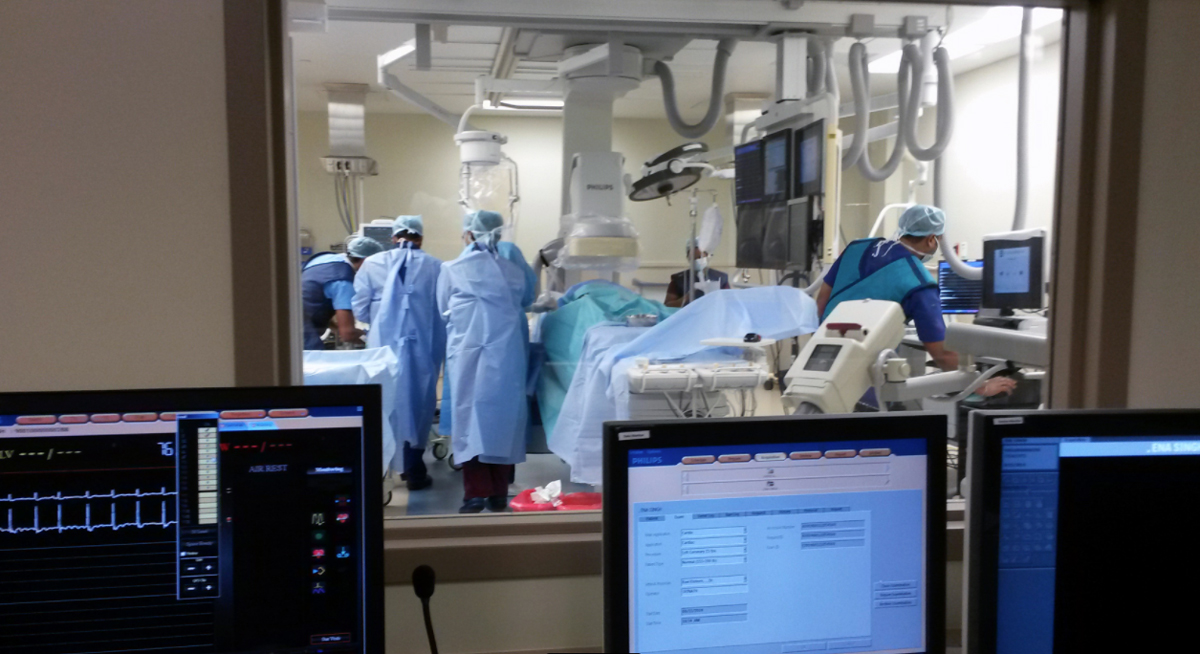
A production-line approach to surgery, combined with chore-shifting among staff, creates an efficient operating theater.
A product-line approach to surgery, combined with task-shifting amongst staff, create an extremely efficient operating theater, resulting in many more procedures completed per day than is typical in the U.S. and elsewhere. Each surgeon performs 400 to 600 procedures annually, compared with 100 to 200 in the U.South.half-dozen All staff members work at the top of their telescopic of practice: surgeons perform only the tasks they are uniquely qualified to exercise, while other clinicians perform tasks such as preoperative preparation, patient didactics, and charting. This enables many surgeries to be performed in a row, with surgeons completing one procedure and speedily beginning the adjacent on a fully prepped patient. This high volume drives lower costs and better-quality outcomes, with surgeons speedily gaining experience and mastery.
Narayana Health's well-known brand, social mission, and stiff leadership — in add-on to competitive bounty and incentive packages — attract and retain highly qualified cardiac surgeons and other tertiary intendance specialists. The system has approximately 16,000 employees, with 11,000 clinicians spread beyond the company, and 4,000 people are subcontracted for housekeeping and security.
Smart Use of Data to Reduce Costs, Monitor Functioning
Use of it and information promote efficiency and standardization throughout Narayana Health. A centralized cloud environment connects all the hospitals, helping to streamline administrative tasks and enable performance monitoring.
The finance team generates profit-and-loss statements for executives every day, allowing them to identify and address uppercase menses issues as they arise. Financial information are reviewed monthly with unit heads and the CEO.
Key performance indicators for individuals and departments are monitored daily, and a real-time patient-complaint process provides a unproblematic and powerful tool to identify and chop-chop correct performance issues.
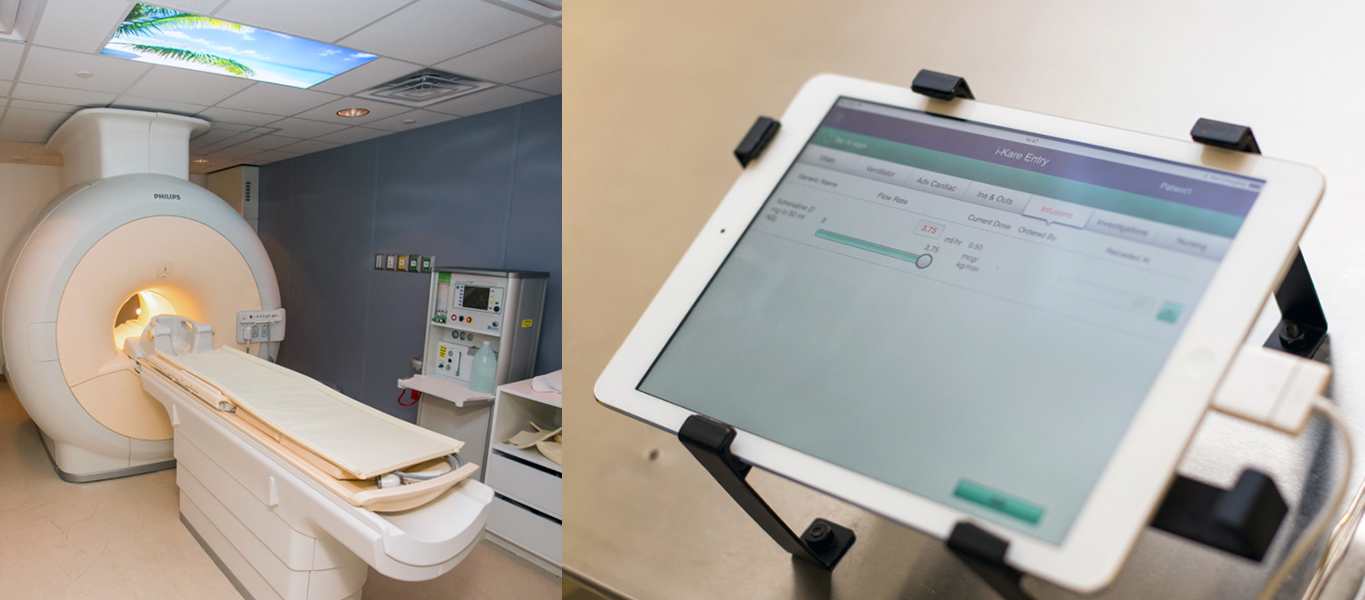
MRI machine (left) and i-Kare tablet (right) are connected to a centralized cloud environs, streamlining administrative tasks.
Providing Affordable Care to All
Narayana Health hospitals serve anyone who needs care, regardless of their ability to pay. Each year, more than than one-half of patients receive costless or subsidized inpatient intendance, with an boilerplate disbelieve of 15 pct. This is accomplished through philanthropy and a cross-subsidy model, in which higher-income patients pay more than for nonclinical civilities, such as private recovery rooms. Since the total charges are even so far beneath the cost of comparable services at other private hospitals, Narayana Health is notwithstanding an attractive option for such consumers. The health system'south business model is sustainable because of its ability to attract and so many patients who can pay total cost.
SPREAD TO THE Caribbean area
In 2014, Health Urban center Cayman Islands (HCCI), a 101-bed tertiary intendance hospital that follows the Narayana model, opened in the Caribbean area island of Grand Cayman, which is part of the Great britain'south Cayman Islands territory. The venture is a partnership between Narayana Health and Ascension Health, the largest nonprofit and largest faith-based health system in the U.S. (Encounter Appendix for details of HCCI's business organisation and staffing models.) Local factors have affected the implementation and success of the Narayana model in the Caribbean area, in both positive and negative ways.
Facilitators of Success
The choice of Grand Cayman was driven by a convergence of factors, including the enthusiasm of local concern leaders, the Caymanian government's need to diversify its economy in the wake of the recent global recession, and Narayana Health'southward desire to plant a presence in the region (see box). The island's well-developed tourism industry, strong infrastructure, low offense rate, and geographic proximity to multiple new markets fabricated it an attractive location.
Key Partners in Health City Cayman Islands
Caymanian businessmen Harry Chandi and Gene Thompson were disquisitional in the genesis of HCCI. Chandi, a Cayman resident of Indian origin, became friends with Narayana Health founder Devi Prasad Shetty, M.D., after he treated Chandi'due south father in India. Thompson was Chandi's business partner and a 3rd-generation Caymanian director of Thompson Evolution Ltd., a major development visitor.
The Cayman regime had approached Thompson about developing avenues for economic diversification. Chandi and Thompson, inspired by Shetty's vision, were vital in brokering relationships betwixt Narayana Wellness and the Cayman government and developing the project's primary plan. "Ignorance is empowerment," said Thompson. "Nosotros knew no boundaries, limits, barriers; nosotros only saw opportunities."
At the same time, Ascension Health, the largest faith-based and largest non-for-profit health organization in the United States, was fatigued to Narayana Health's mission-driven approach. A subsidiary of Ascension, TriMedx, had been collaborating with Narayana to service equipment across its usual lifespan, resulting in reduced upper-case letter expenses and operating costs. The executive leadership team at Rising saw the investment in HCCI as a way to provide affordable wellness care while affording the opportunity to test innovative quality- and toll-improvement strategies that could apply to the United States.
The Caymanian authorities'southward willingness to make sweeping changes to the regulatory and policy environments to adapt HCCI was critical. The government changed nine laws and thirteen regulations in ii and one-half years, including its health exercise police, which now recognizes Indian medical qualifications and approves Indian doctors and nurses to practice in the Caymans. Tort reform capped medical malpractice awards at $620,000, thereby reducing insurance costs for the hospital.7 Immigration constabulary was inverse to support expedited visa processing for people from countries that require a visa to enter One thousand Cayman, and the duty tax was waived for imported medical supplies. The government too preapproved expansion to lucifer the project's 15-twelvemonth principal plan (see Appendix).
Efficient methods (eastward.g., edifice with insulated physical forms that decrease air conditioning employ by 40 per centum) led to fast and affordable construction of the HCCI infirmary, resulting in completion within upkeep in 12 months.
Challenges
In its early stage, several factors threatened to hinder the success of the model in Grand Cayman, including differences between the Narayana and local work culture, higher operational costs, and prevalent misconceptions well-nigh the infirmary that discouraged local patients from seeking services.
HCCI imports most of its clinical staff from India, a do that may be difficult to continue as information technology grows. Hospital leaders are working to embed the Narayana Health work culture, including continuous improvement, balancing multiple roles as needed, and task-shifting, among local clinicians. Notwithstanding, the model will likewise need to adapt to cultural norms in the Cayman Islands.
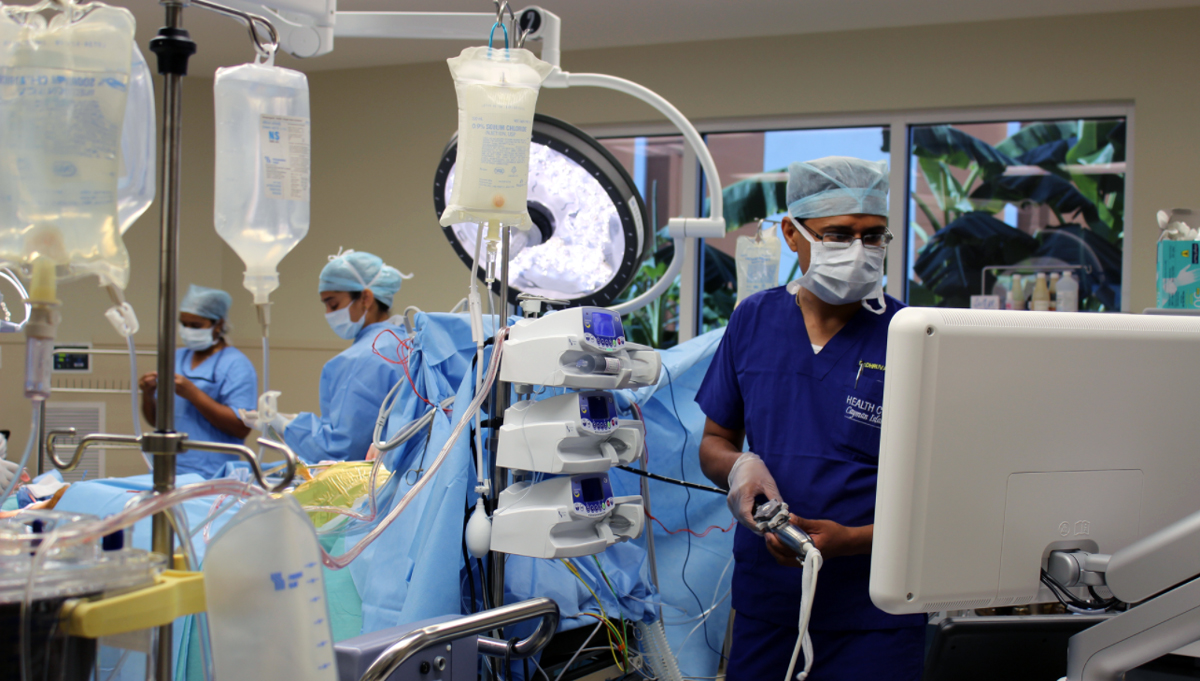
The construction of Health Urban center Cayman Islands incorporates natural light in all areas of the hospital, especially operating rooms.
Higher operational costs and the supply chain logistics of an island also present challenges. Hospital leaders are looking for ways to reduce operational costs through approaches such as utilise of solar power, and are importing some supplies from India to find lower prices.
HCCI has also had to dispel myths that discouraged local patients from seeking care, including perceptions that low cost means low quality, that the hospital is a medical tourism institution that would not serve locals, that Indian doctors weren't as good as Western doctors and might not speak English language, and that the but services offered were through telemedicine. To aid address these misconceptions, HCCI provided care to a few notable Caymanians, who then became advocates for the hospital.
Efficiency in Construction
HCCI'southward structure integrated many concepts from India, including Shetty's philosophy of incorporating natural light into all areas of the building, especially operating rooms. There was a firm commitment to lean and green hospital design.
For example, on-site oxygen manufacturing, apply of solar power, and recycling water for nonpotable uses, mitigated environmental concerns, and should pb to long-term price-savings "The sum full of multiple efficiencies in the construction procedure had greater affect than 1 silvery bullet of saving," says Thompson, a Caymanian businessman who helped develop HCCI.
The hospital was built at $420,000 per bed, compared with an boilerplate of $1 million per bed in the United States. HCCI has simply over 100,000 foursquare feet, less than one-half the size of a typical Western hospital. This small footprint has also led to operational savings.
Plan for Growth
In the short to medium term, HCCI is marketing its services to Caymanians and other Caribbean residents and Latin Americans covered past regime or private insurance, as well as wealthy patients who pay out of pocket. Through a partnership with the Heart to Heart organization, HCCI also provides subsidized cardiac surgery for Haitian children. U.South. residents covered by traditional insurance are non the immediate target of patient growth, though self-insured companies may be willing to partner with HCCI.
To date, HCCI'south clinicians have focused on orthopedic surgery (32%) and cardiology procedures (26%), with 15 percent in cardiac surgery, thirteen percent in full general surgery, and 14 pct in other specialties. Every bit the volume of patients increases, HCCI is expanding its specialties. New services include medical oncology, spine surgery, bariatric surgery, neurosurgery and neurology, plastic surgery, and urology. A slumber lab, sports medicine, surgical oncology, and a cancer institute with a radiation unit are expected.
The long-term plan also includes expansion to ii,000 hospital beds within xv years, opening of a medical academy, and a 1,500-unit of measurement assisted living facility that will serve people needing twenty-four hours-to-day medical supervision as well every bit healthy retirees wanting medical services nearby. Pharma-tourism — whereby people travel to buy cheaper medicines — is also seen as a potential growth surface area.
RESULTS
Narayana Health
The Narayana Wellness model has been rigorously studied and its impacts on clinical quality and outcomes, access to intendance, and costs are well documented in the peer-reviewed literature. In 2007, the wellness arrangement was responsible for 12 percent of all cardiac surgical procedures performed in Republic of india, with 25 procedures completed daily, six days per week.8 Equally noted higher up, its surgeons speedily develop expertise, resulting in patient outcomes that rival those in the Usa. For example, Narayana Health reports a ane.4 per centum bloodshed charge per unit inside thirty days of coronary artery bypass graft surgery, compared with 1.ix percentage in the U.S.9 Information technology also reports a 1 percent mortality rate for mitral valve replacement, and a door-to-balloon time of less than 90 minutes for 91 percent of cases; both rates exceed international benchmarks (Exhibit i).x
Narayana Wellness's operations in India are profitable. Fourscore percentage of its total revenue is generated from inpatient visits, 10 per centum from outpatient visits, and 10 percent from remote consultations and diagnoses. To place cost drivers and support efforts to further increase efficiency, the system is working with Stanford University researchers to develop a model to mensurate the time and cost of each part of the patient encounter, from walking in the door through follow-up. Colleagues at Duke University are working with HCCI to develop a similar model, which will let managers to target specific means to drive efficiencies.
Health Urban center Cayman Islands
Although it is too early on to analyze HCCI'due south treatment outcomes, the hospital'southward cost reward is evident. HCCI's arranged pricing structure is typically set at thirty percent to 50 percent of U.Due south. fees for the aforementioned procedures. For example, coronary artery bypass graft (CABG) surgery typically costs $100,000 or more in the Usa, while HCCI charges around $25,000. HCCI is focused on expanding services and reducing costs further, with the ultimate goal of providing CABG surgery for $15,000 and joint replacement surgery for $10,000.
HCCI appears to be well positioned to change the status quo related to the costs and processes of surgery for the Americas and the Caribbean. Nonetheless, sustainability will depend on the company's ability to increase patient volume in all clinical areas.
POTENTIAL FOR SPREAD IN THE UNITED STATES
Narayana Wellness is a proven model of what'southward known equally "frugal innovation," providing high-quality outcomes for lower price and thereby expanding access to disquisitional services. Information technology shows that the combination of several different, focused innovations can lead to dramatic results, without necessarily having to disrupt existing systems. While it is unlikely that the model could exist replicated wholesale in the U.S., because of the regulatory changes that would be required, it offers lessons on how to significantly reduce costs.
One aspect of the Narayana Health model that is particularly relevant for the U.S. — which spends more on health care than other high-income countries but has worse outcomes — is its focus on finding efficiencies in every aspect of operations and putting the savings to work to increment access and affordability for patients.11 At Narayana Health hospitals, each receptionist, billing specialist, nurse, lab technician, and dr. knows the costs of every material they use and every procedure they recommend. Similar tools to identify cost drivers could be adopted in the U.South., edifice on existing efforts to promote price transparency. Having more data on the costs of care and out-of-pocket costs to patients could motivate U.S. health care providers to increase efficiency, particularly if reducing costs meant that more than people could receive high-quality, affordable care.
There is likewise opportunity in the U.S. to rely on advanced practice providers, including dr. assistants and nurse practitioners, to provide many more aspects of medical and surgical care. Such chore-shifting, combined with a "focused factory" approach to patient throughput, could clear bottlenecks in surgery and lead to higher volumes, better outcomes, and toll reductions.12 Some U.South. providers are following similar approaches, including CareMore, which manages a Medicare Advantage plan that uses nurse practitioners and other team members to offer chronic illness management services and deploys physicians to care for sicker patients. Iora Health employs lay health coaches to encourage behavioral changes in patients, freeing upwards time for clinicians to concentrate on diagnosis and handling.13
Targeting Multiple Markets
In the Cayman Islands, employers are required past law to offer wellness insurance coverage to their employees. Those who exercise non have employer-sponsored coverage are covered by government plans, resulting in nearly universal insurance coverage and very depression out-of-pocket expenditures for patients. HCCI reports that for its Caymanian patients, 95 percent of wellness spending is through insurance, an anomaly in the Caribbean. HCCI has contracted with insurance providers in the Cayman Islands and is working to concenter local residents, including higher-income patients who typically have gone abroad for specialty care because local services have been scarce or unavailable.
Nonetheless, Cayman Island's population of just 55,000 is not sufficient to bulldoze the efficiencies that are the hallmark of the Narayana Wellness model. Therefore, the HCCI marketing squad is analyzing wellness care service gaps in the Caribbean market. It is working with insurance companies, self-insured companies (which have greater incentives than exercise traditional insurers to cut costs), and cruise lines. The main targets for nigh-term growth are Jamaica, Turks and Caicos, the Bahama islands, Trinidad, St. Maarten, and the Dominican Republic.
In April 2015, HCCI earned accreditation by the Joint Commission International, making it one of the youngest hospitals to receive the international certification. This has given the infirmary significant credibility and should strengthen its ability to attract customers from regional and international markets. HCCI's medium-term strategy volition be to target patients from the The states and Canada, with longer-term prospects from South America and Europe. In Canada, for example, marketing strategies target people for whom the opportunity price of waiting for surgery outweighs the price of paying out of pocket at HCCI.
Emerging provider payment mechanisms also may serve as incentives for U.S. wellness systems to prefer many of the frugal innovations adult by Narayana Wellness. The spread of bundled payments for episodes of care, likewise every bit accountable care contracts that concur providers financially responsible for the quality and total costs of designated patient groups, shift greater financial risk to providers — thus creating greater urgency to reduce costs while maintaining quality. Large self-insured employers are also driving utilization of high-volume centers of excellence for high-acuity services, such as the collaboration between Lowe's and the Cleveland Clinic.xiv Connected growth in such arrangements could promote the Narayana Health model of high-volume specialization. Finally, the increasing availability of health care price and outcomes data may create incentives for employers to wait for more efficient health care providers.
Past bringing high-quality, low-toll specialty intendance inside a few hours of travel time from the U.S., HCCI has created an alternative to U.S.-based care that could, over time, force health systems to reduce prices or risk losing market place share. Surgical handling of cardiovascular diseases, cancer, and orthopedic conditions (including joint replacements) are top drivers of U.Due south. health care expenditures, and need for these services will increase with the aging population.
Unlike other medical tourism destinations such as Thailand and India that require significant travel or out-of-pocket payments from international patients, the HCCI model can exist implemented in conjunction with U.Southward. insurance companies, which are increasingly covering medical tourism. BlueCross' Companion Global Healthcare plan, supported by BlueCross BlueShield of S Carolina and BlueChoice HealthPlan of South Carolina, is i such framework already in place.xv Insurers and large employers could cover the entire toll of travel for the patient and a companion to Grand Cayman, surgery at HCCI, and postoperative care at home and still potentially save half the average costs of the procedure in the United states of america.
While full-scale replication of the Narayana Health model in the U.Southward. is unlikely, U.S. health care providers can learn and use lessons from this efficient and results-driven provider.
APPENDIX. HEALTH Urban center CAYMAN ISLANDS
Business Model
Narayana Health'due south mission to serve all patients, regardless of their ability to pay, is sustained through the health system's efforts to bulldoze down operational costs, promote loftier patient volume, and attract a substantial proportion of full-pay patients by offering high-quality care and lower costs than the competition. The Health Metropolis Cayman Islands venture seeks to replicate this success, while adjusting its approach to see the needs of a unlike population, payer mix, and operating environment.
The toll of building and launching the HCCI infirmary was $70 1000000. Compared with Bharat, the cost of utilities, personnel, and supplies are far college in Grand Cayman, and many of these costs will remain higher. To assistance reduce utility costs, HCCI recycles h2o for reuse and is planning a solar farm. Some operating costs will be reduced over fourth dimension by economies of scale and evolution of more efficient supply chains.
For example, to capitalize on Narayana Health's low-price supply chains, HCCI procures most supplies direct from India. Even though the added fourth dimension and unpredictable nature of sea transport complicate inventory direction, supplies imported from India nevertheless price a fraction of what they would cost in other markets. Medicines are procured from FDA-approved companies in India when possible, and the remainder come from the United states of america or the United Kingdom. As patient volumes increase, HCCI expects to shift from on-demand orders to majority orders, lowering costs. True to the Narayana model, HCCI doctors are involved in the acquisition process to ensure they consider costs and avoid unnecessary expenses.
The Narayana Health business model is designed for Republic of india, where a majority of health expenditures are out of pocket (58% of total health expenditures) and most patients finance their own intendance.a To serve the Cayman Islands and Latin American markets, where the majority of people are insured, HCCI must adjust its pricing, billing, and marketing strategies to the preferences of insurers. Whereas Narayana Wellness pricing is transparent, HCCI does not publish prices because it needs to allow for negotiation with insurance companies. HCCI uses arranged, fixed pricing, rather than billing by codes, and typically sets prices at one-third to 1-half of average U.Due south. prices. Eschewing billing codes in favor of bundled pricing for procedures results in significant efficiencies for HCCI (it employs only two billing staff for the unabridged hospital) and caps risk for insurance companies. The bundled prices include consultations, preoperative and postoperative investigations, admission charges, surgical fees, operating room fees, anesthesia, implant costs, room and food charges, medications and surgical consumables, transportation, and all medico visits upwardly to two weeks after surgery.
While bundled pricing would seem to be attractive to U.S. insurers, HCCI has learned that most private U.S. insurance companies however want to receive itemized bills to match U.S. billing codes, though many are piloting bundled payment models.
Narayana Health leaders report that well-nigh 70 per centum of the patients at its Cardiac Infirmary pay in greenbacks at the fourth dimension of service. All the same, HCCI faces 45-to-50-day waits to receive payment from insurance companies, making greenbacks-menses direction more difficult.
Staffing Model
Like Narayana Health, HCCI utilizes lean direction principles. For example, staffing is planned according to the minimum requirements based on patient volume. HCCI staff also typically vesture multiple hats every bit appropriate for their competencies, skills, and training (east.g., the caput of internal medicine likewise heads the pharmacy). This is partly a role of electric current patient volume, but also reflects a cultural ethos HCCI sought to replicate by bringing teams from India, about of whom were trained at Narayana. Having the power to balance multiple tasks is a key criterion in selecting candidates for HCCI. Internal hiring is besides prioritized to maintain the stiff organizational culture.
To date, there are 268 employees at HCCI, with about ii-thirds recruited from India. The majority of clinical staff were recruited from Narayana Wellness in Bharat, in office because there are not plenty medical specialists locally. Importing clinicians from Narayana as well promotes allegiance to its piece of work civilization.
HCCI has committed to the Caymanian government to maintain a minimum of 25 pct to 30 pct local employees (currently at thirty%). To see this goal over the long term, HCCI launched a student intern plan (with 300 interns expected) and is working with the government to strengthen the schoolhouse scientific discipline curricula and increase students' exposure to the health care professions. In 15 years, HCCI plans for ane-third of its staff beyond all categories, including clinical, to be Caymanian.
Policy and Regulatory Changes Made to Enable HCCI's Model
The Caymanian regime worked with Narayana Wellness and Ascension to modify laws and regulations to enable the adaptation of the Narayana model to the Caymans. Changes were fabricated to the post-obit laws, which were implemented through changes to thirteen regulations.
- Wellness Practice Police
- Tort Reform Law
- Organ Transplant Law
- Organ Importation Police
- Planning Constabulary
- Community Police force
- Immigration Law
- Registered Country Police
- Local Companies Control Law
a Earth Health Organization Global Health Expenditure Database.
DOWNLOAD HERE
Posted by: janeneuposteave1994.blogspot.com
 Download UPDATED)
Post a Comment for "Narayana Hrudayalaya Heart Hospital: Cardiac Care For The Poor (A) Download UPDATED"